From Managing Promotions to Letting the System Do the Work.
Vagaro was replacing a $10-a-month subscription with a marketplace that only earns when a booking arrives. I was asked to build a manual marketing tool: one businesses would have to run every week. So I designed a system that runs itself instead.
Data as of August 27, 2026 · two months post-launch.
As lead product designer, I owned Fill My Books from strategy through execution. I challenged the original product direction — from manual process to designing the operating model and the decisions about what the system would be allowed to do on a business's behalf.
The idea was to automate promotions. I wanted to eliminate the work.
The Fill My Books brief I received was to use an existing marketing model: a deal builder. Businesses set services to discount, reviewed deals we generated, chose which promotions should run, and repeated the process each week.
A product designed to fill empty appointments shouldn't make businesses manage another marketing tool. I pushed for a different model: businesses should define their goals once, and the system should do the rest.
Under a subscription, a tool that goes unused still collects $10 a month. Under performance pricing, a tool that goes unused collects nothing.
DESIGNING THE SYSTEM
Moving the work from the business into the system.
Businesses define goals. Vera executes.
A business's entire contribution to this product happens on one screen, once. It picks a goal — bring me new customers, or fill my last-minute gaps — sets a discount floor, chooses which services are eligible, and marks the times it doesn't want promoted.
Everything it used to do weekly — which service to discount, how deep, for whom, and when — became either a boundary it sets once or a decision Vera makes every time a slot opens.
One screen. Set once. Vera handles everything after.
Vera uses these inputs to determine what happens next.
Why not approval
The safer version was a proposal model: Vera drafts a promotion, the business reviews and approves it, then it goes live. I pushed against it. Approval reintroduces the workflow we had just removed — a business reviewing promotions is still managing campaigns. And it fails hardest where the product matters most: a slot that opens at 2pm for a 4pm appointment is precisely the promotion nobody is sitting at a desk to approve.
The tradeoff
We gave up the human check on individual deals. Control moved upstream instead — into boundaries the business sets once, enforced on every slot before anything reaches a customer.
Vera needed a decision framework.
Delegation without structure isn't automation — it's abdication. Vera needed to know exactly which decisions were hers to make and which the business had already made by setting goals.
The line between business and system wasn't just conceptual. It had to be explicit — visible to the business as a contract, and enforced on every slot before anything reached a customer.
A business sets its rules once. From then on every eligible slot is checked against those rules, matched to a customer, priced, and turned into a booking — with no one creating a promotion.
The system needed to know where to create value first.
Vera needed a place to start. The marketplace had 80 million customers — but targeting the wrong segment first would undermine trust before the system had a chance to earn it.
We started with customers who had no existing relationship with the business. That gave Fill My Books a clear value proposition: the marketplace wasn't taking credit for a customer the business already had — it was creating a new opportunity.
Phase 1 creates value without competing with existing relationships. Phase 2 deepens it.
The economics reflected the value created — higher fees where the relationship was new.
Returning customer
5%
Recovers revenue that was about to disappear
New customer
20%
Creates a relationship that keeps earning
The fee structure followed the value created: higher fees for new customers, lower fees when the relationship already existed.
What the system had to work around
A system that acts on a business's behalf can only be built inside what's actually possible. Most of my work across six teams was finding those edges early enough that the design could absorb them.
Three of these constraints pointed at the same answer from different directions. That convergence is a large part of why I was confident the intent model was right rather than merely elegant.
Drag, scroll horizontally, or use arrows to navigate
My role wasn't designing the interfaces on top of this system. It was deciding what the system was allowed to do, and keeping six teams building toward the same answer.
Building trust
Automation only works if people trust it
Removing manual approval raised the stakes on transparency rather than lowering them. A business that no longer reviews each promotion has no way of knowing what happened unless we show them.
So reporting became the substitute for the approval step we deleted. It couldn't just report bookings — it had to answer the question a business has when it delegates something: was this worth it?
Under the old model a business paid $10 a month and had no way to know what it bought. Here, every dollar of fee has a booking attached to it.
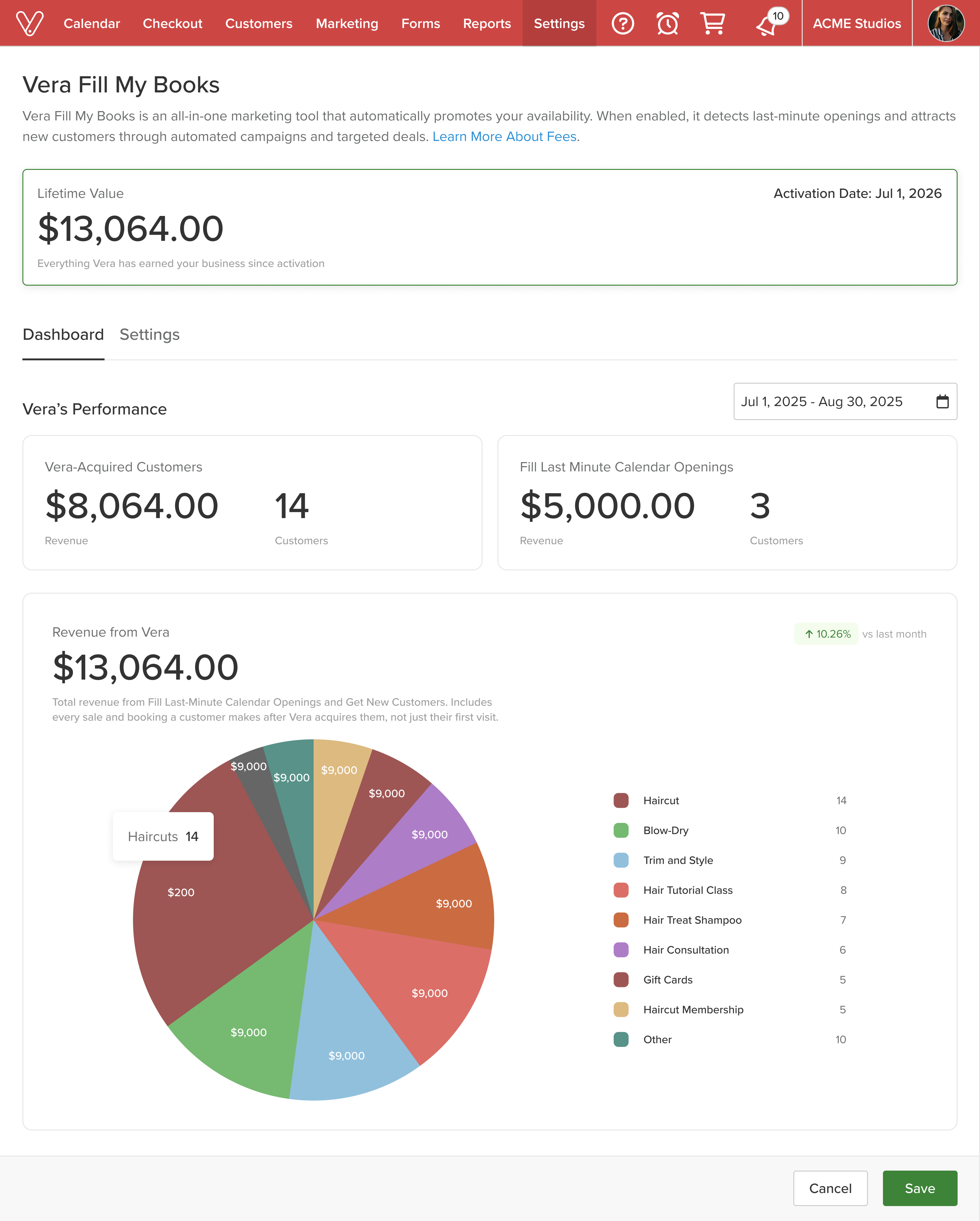
Reporting view — bookings, revenue, and ROI attributed to Vera.
Transparency wasn't a reporting feature. It was the price of autonomy.
POST-LAUNCH
Did businesses actually let go?
Completely. 75% of bookings and revenue came from promotions no business created, across 87% of active businesses.
6×
Prior AI use was the strongest adoption signal in the data.
Businesses already on Connect AI adopted at 42.6% against a 7.3% base. Whether that's comfort with delegation or simply platform investment, it's where the next AI product should start.
1 in 4
Businesses didn't choose automation or control — most took both.
A quarter of bookings still came from deals businesses made themselves, from the same businesses running Vera. They delegated the routine and kept a lever for what they cared about.
What I'd design next
Some businesses turned it on and saw nothing for a while. Because they'd stopped checking, they couldn't tell whether it was working or simply hadn't matched yet — there's no state that says Vera is looking. For a product that promises you don't have to check, that's the gap that matters.
70.7% stayed on a product that charges them per booking. The subscription it replaced retained effectively 100% — because leaving required cancelling. The number went down and the signal got better.
The system worked because businesses didn't have to
Fill My Books created a three-sided outcome: businesses filled empty appointments and gained new customers, consumers received deals matched to what they had actually booked before, and Vagaro earned revenue at a fundamentally different scale. Three quarters of it came from promotions no business created.
Value to Businesses
Salons & service providers on Vagaro
returned to businesses for every dollar Vagaro earned
$4.58M in total sales from businesses
slots filled that would have been empty
Value to Customers
Consumers buying the deals
discovered a new business
Relevant promotions
based on past appointments and AI targeting
Value to Vagaro
Platform revenue from performance fees
compared to the old model
in revenue
The most valuable outcome wasn't the revenue. It was proving that businesses will delegate real decisions to a system that only gets paid when it's right — which is now the template for every AI product Vagaro builds on top of this one.
Designing what holds it together
Reflection
I design the boundary between what a person decides and what a system decides.
Fill My Books reinforced what I enjoy most about product design: turning complex systems into experiences that feel simple. The goal isn't just to automate the work: it's to make delegation trustworthy.
I design what holds it together.